Analysis of LED Technology in Automotive Lighting: Trends, Safety, and Future Development
An in-depth analysis of LED adoption in automotive lighting, covering technological advantages, safety implications, and future trends in autonomous vehicle sensing.
Home »
Documentation »
Analysis of LED Technology in Automotive Lighting: Trends, Safety, and Future Development
1. Introduction
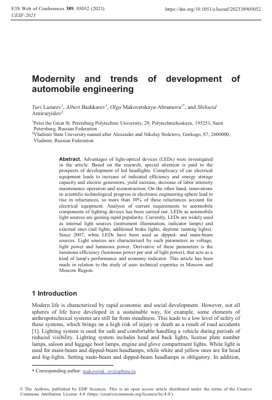
This analysis examines the pivotal transition from traditional automotive lighting to Light-Emitting Diode (LED) technology, as outlined in the research by Lazarev et al. The paper positions LEDs not merely as an energy-efficient alternative but as a foundational technology enabling advanced safety and sensing systems, particularly for the future of autonomous vehicles. The core argument revolves around the dual benefit of LEDs: improving vehicle electrical system efficiency while simultaneously creating new data channels for vehicle-to-everything (V2X) communication and environmental perception.
2. Core Analysis & Technical Framework
This section provides a structured, critical evaluation of the research paper's claims and their implications for the automotive industry.
2.1 Core Insight: The LED Paradigm Shift
The paper's fundamental insight is that LEDs are transitioning from a component to a platform. While correctly highlighting efficiency gains (luminous efficacy) and reliability, the authors' most prescient point is the enabling role for Visible Light Detection and Ranging (ViLDAR). This mirrors a broader industry trend where single-function hardware evolves into multi-purpose sensor suites, similar to how camera modules in smartphones now serve photography, biometrics, and AR. The claim that over 30% of vehicle electrical loads relate to lighting and associated equipment underscores the systemic impact of this shift—it's not just about the bulb, but about redesigning power architecture.
2.2 Logical Flow: From Illumination to Intelligence
The paper's logic chain is compelling but slightly optimistic. It posits: 1) LED adoption increases → 2) Electrical system efficiency improves & light becomes digitally controllable → 3) This enables ViLDAR and new sensing modalities → 4) Which feeds data for autonomous driving. The flaw here is assuming a linear progression. The real challenge, as seen in LiDAR and radar development (e.g., the cost-performance trade-offs discussed in the CycleGAN paper for sensor data simulation), is in sensor fusion and data processing. The paper rightly identifies the weakness of RF-based systems (interference, angular dependence) but understates the monumental software challenge of making ViLDAR robust in diverse weather and lighting conditions.
2.3 Strengths & Flaws: A Critical Assessment
Strengths: The paper successfully links a mature technology (LEDs) to the cutting-edge narrative of autonomy. Its focus on the Moscow region case study, while limited, provides a concrete context for examining real-world adoption barriers. The emphasis on standardization (e.g., regulations on beam patterns and allowable configurations) is crucial, as regulatory hurdles often lag behind technological capability.
Flaws & Omissions: The analysis is notably silent on cost. LED and, especially, matrix LED or digital light processing (DLP) headlights remain premium features. The paper misses a critical discussion on thermal management—high-power LEDs generate significant heat, requiring complex heatsinks that impact design. Furthermore, while mentioning "rapid popularity," it lacks quantitative market penetration data from sources like Yole Développement or McKinsey, which would strengthen the argument.
2.4 Actionable Insights for Industry Stakeholders
For OEMs & Tier 1 Suppliers: Double down on integrating lighting with ADAS/AD stacks. Don't treat the headlight team and the autonomy team as silos. Invest in developing "communication-grade" LEDs capable of high-frequency modulation for reliable Li-Fi (Light Fidelity) data transmission, a natural extension of ViLDAR.
For Regulators (e.g., NHTSA, UNECE): Begin drafting standards for visible light-based sensing and communication now. The current regulatory framework (FMVSS 108, ECE R48) is ill-equipped for adaptive, data-emitting lights. Proactive regulation can prevent a future patchwork of incompatible systems.
For Investors: Look beyond the LED chip manufacturers. The value will accrue to companies that master the integration: software for adaptive beam patterning, control units that fuse optical data with radar/camera inputs, and thermal management solutions.
3. Technical Details & Mathematical Models
The key performance metric for lighting sources is Luminous Efficacy ($\eta_v$), defined as the ratio of luminous flux ($\Phi_v$) to electrical power input ($P_{elec}$).
$\Phi_v$ is the luminous flux, measuring the perceived power of light in lumens (lm).
$P_{elec}$ is the electrical power in watts (W).
Modern automotive LEDs can achieve $\eta_v > 150$ lm/W, significantly outperforming halogen (~20 lm/W) and Xenon HID (~90 lm/W) technologies. For a ViLDAR system, the modulation capability is critical. The signal can be modeled by modulating the drive current $I(t)$:
$$I(t) = I_{dc} + I_{m} \cdot \sin(2\pi f_m t)$$
where $I_{dc}$ is the bias current for baseline illumination, $I_m$ is the modulation amplitude, and $f_m$ is the modulation frequency (potentially in MHz for data transmission). The resulting light intensity $L(t)$ follows a similar pattern, enabling the encoding of information.
4. Experimental Results & Performance Metrics
While the source PDF does not present specific experimental data tables, it references findings from auto technical expertise in Moscow. Based on industry benchmarks, the transition to LEDs yields the following results:
Energy Efficiency Gain
> 75%
Reduction in power consumption for headlight function compared to halogen systems.
System Reliability
~50,000 hrs
Typical LED lifetime (L70), drastically reducing maintenance needs versus ~1,000 hrs for halogen.
Electrical Load Impact
~30%
Proportion of vehicle electrical system load attributed to lighting and related equipment, as cited in the paper.
Chart Description (Implied): A dual-axis chart would effectively visualize the correlation. The primary Y-axis shows the market penetration rate of LED headlights (from <5% in 2010 to >80% in new premium vehicles by 2023). The secondary Y-axis shows the average luminous efficacy (lm/W) of automotive lighting assemblies, demonstrating a steep climb coinciding with LED adoption. A third line could plot the decreasing cost per kilolumen ($/klm), highlighting improving economics.
5. Analysis Framework: ViLDAR Case Study
Scenario: A vehicle (Ego) approaches an intersection at night. A second vehicle (Target) is approaching perpendicularly, potentially running a red light. Traditional sensors (camera, radar) may have limitations (camera glare, radar clutter from infrastructure).
ViLDAR-Enhanced Analysis Framework:
Data Acquisition: Ego vehicle's front-facing ViLDAR system detects the modulated light signature from Target vehicle's LED headlights or tail lights.
Parameter Extraction: The system calculates:
Relative Velocity: Derived from the Doppler shift in the modulated light frequency ($\Delta f$).
Distance: Calculated via Time-of-Flight (ToF) or phase-shift measurement of the light signal.
Direction: Determined by the pixel location on the dedicated ViLDAR sensor array.
Sensor Fusion: These parameters ($v_{rel}$, $d$, $\theta$) are fed into the vehicle's central perception model (e.g., a Kalman Filter or deep learning-based tracker) and fused with data from cameras and radar.
Decision & Action: The fused data model predicts a high-probability collision path. The Autonomous Driving (AD) system triggers emergency braking and an audio-visual alert for the driver.
This framework demonstrates how LED lighting transitions from a passive safety feature ("see") to an active sensing node ("be seen and communicate").
6. Future Applications & Development Directions
Standardized V2X Light Communication (Li-Fi): LED headlights and tail lights will broadcast basic vehicle state information (speed, braking intent, trajectory) to nearby vehicles and infrastructure, creating a redundant, high-bandwidth, and low-latency communication layer complementary to C-V2X or DSRC.
High-Definition Dynamic Lighting: Beyond adaptive beam patterns, "digital headlights" will project information onto the road—highlighting pedestrians, projecting lane markings in fog, or displaying warnings directly in the driver's field of view.
Biometric & Driver Monitoring Integration: Interior LED-based ambient lighting will be used with spectral sensors to monitor driver vitals (e.g., pulse via photoplethysmography) or attentiveness through pupil tracking.
Sustainability & Circular Design: Future development must address end-of-life for LED assemblies, focusing on rare-earth element recovery and modular design for repair-ability, aligning with EU Circular Economy Action Plan directives.
7. References
Lazarev, Y., Bashkarev, A., Makovetskaya-Abramova, O., & Amirseyidov, S. (2023). Modernity and trends of development of automobile engineering. E3S Web of Conferences, 389, 05052.
United Nations Economic Commission for Europe (UNECE). Regulation No. 48: Uniform provisions concerning the approval of vehicles with regard to the installation of lighting and light-signalling devices.
Zhu, J., Park, T., Isola, P., & Efros, A.A. (2017). Unpaired Image-to-Image Translation using Cycle-Consistent Adversarial Networks. IEEE International Conference on Computer Vision (ICCV). (Cited for methodology on synthetic sensor data generation).
Yole Développement. (2023). Automotive Lighting: Technology, Industry and Market Trends Report.
National Highway Traffic Safety Administration (NHTSA). Federal Motor Vehicle Safety Standard (FMVSS) No. 108.
Haas, H. (2018). LiFi: Conceptions, misconceptions and opportunities. 2018 IEEE Photonics Conference (IPC). (For principles of light-based communication).